Expertise
Our approachCasesCareersContactSEA
SEO
CRO
Social
Data
AI Marketing
WHAT WE SPECIALISE IN
SEO
Social


In the field of digital marketing, there are a couple of terms that keep cropping up: “SEO” and “SEA”. Seasoned webmasters, marketing professionals and forward-thinking entrepreneurs will have no trouble telling the two apart. But what do these words mean for everyone else, or for entrepreneurs who are just starting out?
SEO stands for Search Engine Optimization. It is the process of optimising a website so that search engines such as Google can rank it in the organic search results. Your website is compared against other websites with roughly the same content, based on various criteria.
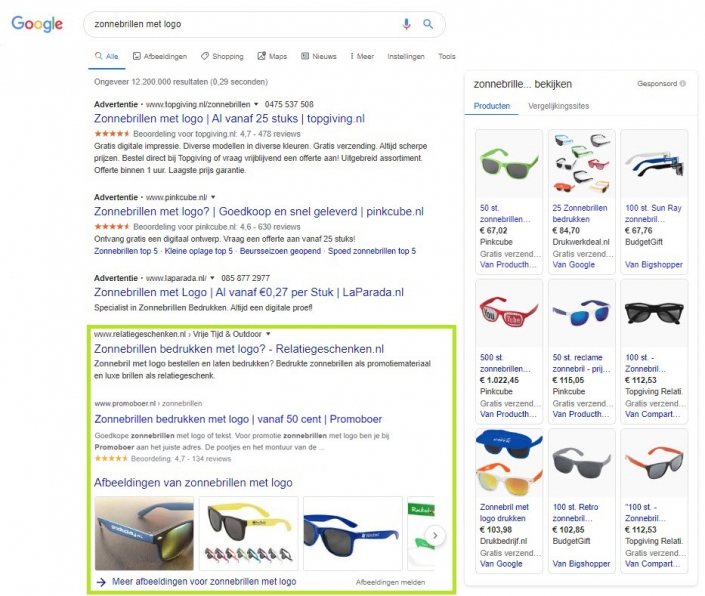
Sounds complicated? Don’t worry! SEO may be tricky to explain in words, but in practice it is easier to show. Below is a screenshot of the search engine results page after someone searched Google for `zonnebrillen met logo` (sunglasses with a logo).
The organic results are highlighted in green. These results are ‘natural’ and, according to Google, the most relevant results for the search ‘zonnebrillen met logo’. Intuitively this makes sense when we think about why someone would search for ‘zonnebrillen met logo’. In all likelihood, the user is looking for printed sunglasses to hand out as promotional material or a corporate gift. Take, for example, the result from Promoboer, shown in second place: in Google’s eyes, it is a useful result. Example images of sunglasses with a logo are also relevant to the search, which is why they are shown in the middle of the results.
So why are these results shown on the first page, and not the 12,200,000 other Google results? The answer is simple. According to Google, these results are the most relevant and reliable, and therefore offer the most value to the searcher.
Thanks to its ability to find the most relevant results for every search, Google has become the largest search engine in the world. Much of this success comes from its ability not only to find the best results, but also to filter out the bad ones. For example, you can add a location to your search, such as ‘zonnebrillen met logo in Haarlem’. You are looking for sunglasses with a logo in Haarlem, so you aren’t interested in results from Groningen or Limburg, and those results are filtered out. Offering value to users is Google’s end game.
Besides relevance, the other half of Google’s equation is reputation. In our ‘zonnebrillen met logo’ example, there isn’t just one provider active: there are probably dozens that could all be considered relevant. To decide which results rank first, Google checks how ‘popular’ the website is. Popularity is determined in part by how many people link back to the site, also known as backlinking. More backlinks suggest that people are essentially talking about the site and recommending it to others, which makes it more popular and valuable in Google’s eyes.
Before an SEO specialist starts carrying out SEO, you first need to map out who your target audience is and what they are likely to search for on Google. You then make your website as relevant as possible for this audience. Meanwhile, you also work on improving your online reputation, for example by acquiring backlinks based on a strategy. Because of the sheer size of the internet, this is a laborious process that requires dedication and patience, often involving months of reputation work before it shows fruitful results. But it is definitely worth it: the more relevant and reliable your website, the higher you score in Google’s organic results. The higher you are in Google, the more cost-effective search engine traffic you will receive. Want to know more about SEO? We are happy to give you more SEO advice. Find more information about our SEO course here.
SEA stands for Search Engine Advertising, also known as PPC or Pay-Per-Click. It is the process of advertising directly on Google and similar search engines, mainly carried out by a Google AdWords specialist. Ad results are shown at the top of and to the right of the organic results on the search engine results page.
Ad results are highlighted in red and are clearly labelled with an “ad” icon. The main difference between ad results and organic results is that you pay Google to have your ad appear. SEA is often called PPC because it is based on the pay-per-click model. You set up an account and an advertising budget in AdWords, Google’s advertising platform, and as soon as users click on your ad, Google charges a pre-agreed amount. The more you are willing to pay for a click, the higher your ad appears on the search engine results page.
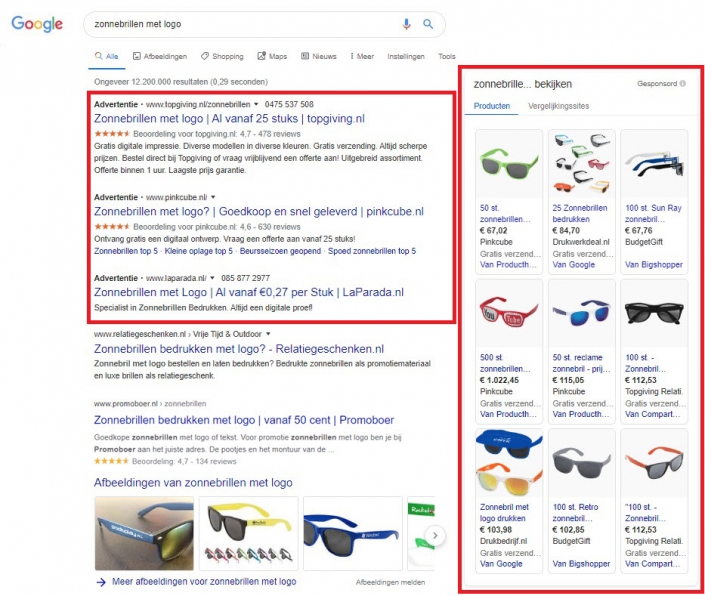
How much you are willing to pay for a click can be set manually in your AdWords account. Depending on your sector and competitors, it can get very expensive to keep (or get) your ads visible. On the other hand, this has the big advantage that your website is shown on Google straight away, and not on page 3, for example.
This doesn’t mean there are no guidelines for SEA and how much you should pay. SEO principles still apply to SEA, mainly with regard to relevance. With AdWords you control which search terms you want to target, which ad copy you want to appear with on Google and which landing page on your website users should end up on. The more relevant your ad copy and landing page are to the search you are targeting, the less you pay when the user clicks on your ad. That means you can afford more clicks to your site than a less relevant competitor.
Managing AdWords is time-consuming, because you can target an almost unlimited number of keywords. To maintain relevance for each keyword, every ad text and landing page has to be tailored and relevant to keep your costs low. You also need to monitor your bids per click to make sure your budget is used as efficiently as possible. Then there has to be ongoing analysis to see which ads perform well and which don’t. And then you evaluate and adjust your campaign accordingly. Want to know more about SEA? Find more information about our Google AdWords training here.
When carried out properly, search engine advertising can send traffic to your website very quickly and effectively. All of this for a fee. It differs considerably from SEO, where it can sometimes take months before Google recognises your optimisation efforts and ranks your site in the organic results, but, unlike with SEA, you don’t pay Google anything directly.
The long-term ROI (return on investment) of correctly implemented SEO is much greater than that of SEA, because users generally trust organic results far more than ad results, with the added benefit that you don’t pay for every click. However, the short-term profit potential of SEA is excellent if you need an immediate, targeted boost in traffic to your website.