Expertise
Our approachCasesCareersContactSEA
SEO
CRO
Social
Data
AI Marketing
WHAT WE SPECIALISE IN
SEO
Social

What will entrepreneurship look like when AI becomes the norm rather than the exception? It is a question more and more entrepreneurs, marketers and educational institutions are actively working on. At the Amsterdam University of Applied Sciences (HvA), and specifically within the Entrepreneurship minor, students and lecturers were asking the same question. What does AI mean for the way you build a business, create content and reach your market? And how do you prepare a new generation of entrepreneurs for a field that is changing fundamentally?
At DGTLbase, we started a conversation about this with the university. We see it happening every day in our own work: marketing teams are getting smaller and faster, content is being made in a different way and the barrier to starting a business is lower than ever.
At the same time, we also see that many entrepreneurs don’t know where to start. Reason enough to share our vision on AI in entrepreneurship with the place where the next generation of entrepreneurs is trained, and where we ourselves once sat in the lecture halls.
The HvA’s question wasn’t whether AI would become relevant. That question had already been answered. The real question was: how do you make AI tangible for students who are about to start out as entrepreneurs or marketers? Theory from books is no longer enough. Students need to feel what AI makes possible, experience where the limits are, and judge for themselves which opportunities they want to seize.
We recognised that question. At DGTLbase we work on the same challenge every day: how do we translate abstract AI possibilities into concrete results for our clients? How do we make sure AI doesn’t remain a buzzword, but becomes a production channel businesses get structural value from?
During the working sessions, we also looked at practical applications of AI beyond text. Think of tools that let you create AI designs, from concept to finished visual, without needing a design background first. Accessible applications like these show that AI isn’t just interesting in theory, but can be put to use straight away in practice.
We believe AI is changing marketing and entrepreneurship at their core. Not by replacing people, but by shifting their role. Where marketers used to spend hours carrying out individual tasks, we now see a shift towards direction: deciding what gets made, which direction the content takes and which strategic choices are made. Execution is partly taken over by AI; judgement and creativity remain human work.
In concrete terms, we see a few clear shifts:
For entrepreneurs, this means the barrier to starting something is lower than ever. But it also means standing out is harder, because everyone has access to the same tools. The winner in this new playing field isn’t whoever uses the best tool, but whoever directs best.
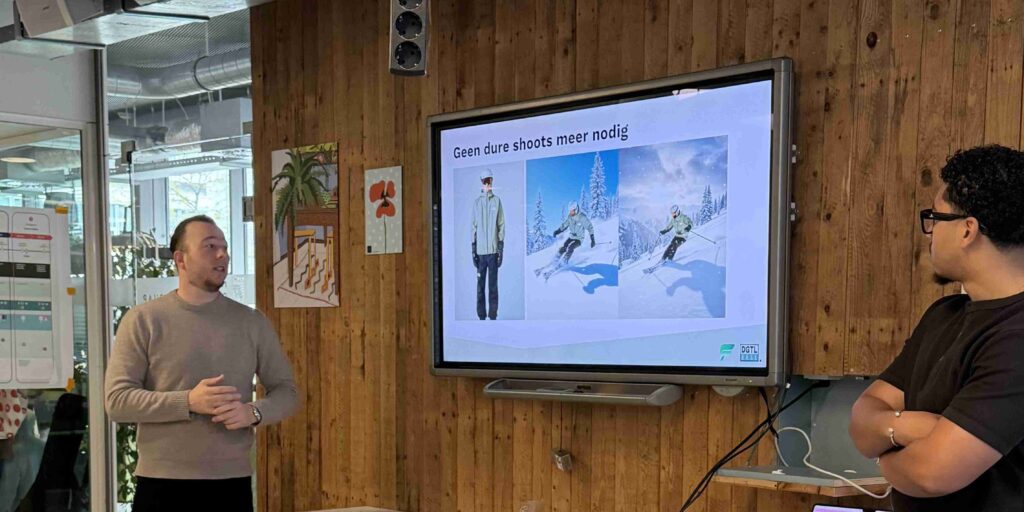
To make this vision tangible for the students, DGTLbase ran several working sessions within the Entrepreneurship minor. We deliberately chose duo sessions, so we could show from different angles how AI affects entrepreneurship.
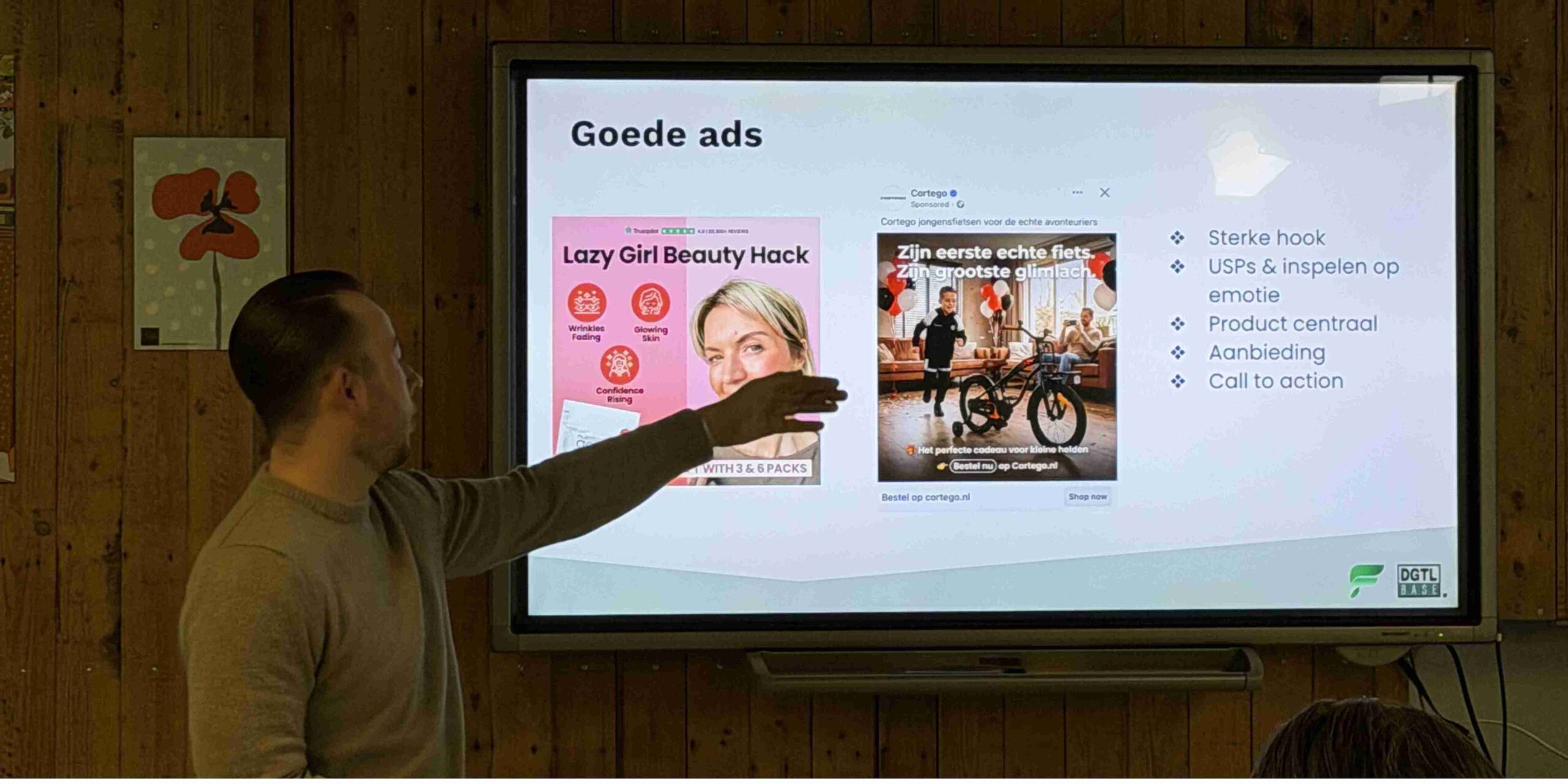
Desmond and Donny gave the first sessions, taking the students through the broader vision on AI in marketing and entrepreneurship. Which shifts do we see in the market? What does that mean for you as a starting entrepreneur? Which strategic choices do you need to make today so you don’t fall behind tomorrow?
In a follow-up session, colleagues Quintin and Karim took over. They brought the vision into practice by having students work hands-on with our own AI tool, Floowy.ai. No demos from a distance, but students pressing the buttons themselves and seeing what happened. What started as a product image without context ended, within a single work block, as a complete campaign visual with atmosphere, a model and a text overlay. The penny didn’t drop through the explanation, but by doing it themselves.
A few principles from our own practice that kept coming back during the sessions:
The biggest enemy of entrepreneurship is perfectionism. You only really learn by doing, not by endless planning. With AI, the barrier to starting is lower than ever: you don’t need perfect product photos or a professional copywriter to start testing.
Success comes from discipline, long days and working consistently on your brand. Not from one viral post or a lucky breakthrough. Whoever tests four variants every week learns faster than whoever launches one big campaign a month.
A common mistake is investing big straight away in something you don’t yet know works. With AI, you test different angles on a small budget. Only once a variant demonstrably performs better do you scale up. What used to cost €1,000 to test, you can now do for €100.
Nobody is good at everything. AI helps you tackle tasks outside your core competence more efficiently, so you can put your energy into what only you can do. But for strategic work that requires deep expertise, working with specialists remains valuable.
A vision only becomes credible when you can back it up with concrete examples. During the sessions, we showed what we do for clients, using cases such as Curlygirlmovement, Welhof, Marcels Green Soap and Nimani as examples. A few examples that really landed:
Giving working sessions at an educational institution isn’t a one-way street. We also learned from the questions students asked. Questions such as “what’s left of human creativity?”, “how will I stand out if everyone has access to the same tools?” and “how much will I pay for something AI can also do?” are exactly the questions the market will need answers to in a few years’ time.
For us, it confirms that our vision is right: AI doesn’t increase what you can produce; it shifts where you add value. Whoever directs, sets the strategy and protects their own identity stays relevant. Whoever only carries out what AI can also do, doesn’t.
In the sessions, we were also honest about the other side. Building a business with AI sounds easier than it is. A few things we ran into ourselves and shared with the students:
The tools are there. The only question is: are you going to use them?
To the question what entrepreneurship will look like in a few years, our answer is clear: hybrid. People and AI work side by side, with people directing and AI executing. The entrepreneurs who master this fastest build faster, learn faster and grow faster than entrepreneurs who cling to old ways of working. At the same time, human expertise isn’t disappearing; it is becoming more valuable in the places where judgement, strategy and originality count.
For the HvA students, that is good news. They are starting out in a market where they can build something faster than ever, provided they make the right choices. For us at DGTLbase, it confirms that working with educational institutions is valuable, not only for the students, but also for our own thinking.
Curious how we use AI in our client projects? Whether it’s about more scalable content, smarter advertising or structural testing, we are happy to translate our vision into concrete results for your brand. See how we work or schedule an introductory call.
Can DGTLbase run working sessions or knowledge sessions for my organisation or educational institution?
Yes. Alongside our client projects, we run working sessions and knowledge sessions on AI in marketing and entrepreneurship. We work with educational institutions such as the Amsterdam University of Applied Sciences, but also with businesses that want to take their team through the possibilities of AI. Sessions often combine vision, strategy and hands-on work with AI tools. Get in touch to discuss the options.
Who are working sessions on AI in marketing suitable for?
Our working sessions are suitable for educational institutions, marketing teams, entrepreneurial students and organisations that want to prepare their team for AI-driven work. They work best for participants who don’t just want to hear what AI can do, but also want to experience how it works. We tailor the session to the level of the group, from students to senior marketers.