Expertise
Our approachCasesCareersContactSEA
SEO
CRO
Social
Data
AI Marketing
WHAT WE SPECIALISE IN
SEO
Social


Retail is tough. The big chains have more budget, more branches and more brand awareness. Webshops are open 24 hours a day. And then there is bol.com. Yet there are retailers in the Netherlands that are growing. Not despite the competition, but by marketing smarter than the rest. In this blog we explain how.
You’re not losing customers because you’re worse. You’re losing them because you’re less visible.
That is the hard truth behind most of the problems retailers bring to us. The shop is good. The range is right. The service is personal. But the customer around the corner doesn’t know it, because they searched online and found a competitor that did show up at the top.
Online marketing for retail isn’t about big budgets or complicated technology. It’s about being visible at the right moment, to the right people, in the right place. That sounds simple. Yet most retailers don’t do it.
Big chains are everywhere. And nowhere really. They have no personal bond with the neighbourhood, no face behind the counter and no knowledge of the local customer.
That is your advantage. But only if you show it online too.
A complete Google Business Profile with up-to-date photos of your shop, your team and your range, the correct opening hours, specific product categories and an active review policy makes sure you are visible when people in your area search. 'Fietsenwinkel Amsterdam Noord', 'speelgoedwinkel Utrecht Overvecht', 'boekwinkel Groningen centrum'. These are searches where a big chain or webshop never beats a local shop that has its Google Business Profile in order.
Reviews are decisive here. Not just for your ranking in Google, but also for customer trust. A shop with forty recent reviews beats a chain with a hundred old reviews. Actively ask for reviews after every purchase.
Big chains and webshops have broad product pages. They sell everything to everyone. They don’t have time to explain which bike suits a beginner who cycles to work three times a week, or which toy suits a four-year-old who loves building.
You do.
That is the SEO opportunity most retailers leave on the table. Not competing on broad keywords, but winning on the specific questions people ask when they want not just a product, but advice as well. An article on 'which road bike suits a beginner with a budget of 800 euros' attracts exactly the visitor who is ready to buy but needs one final nudge.
Pages per product category with real information, comparisons and advice. A blog that answers the questions customers also ask in your shop. That is the content Google rewards and that big chains will never write.
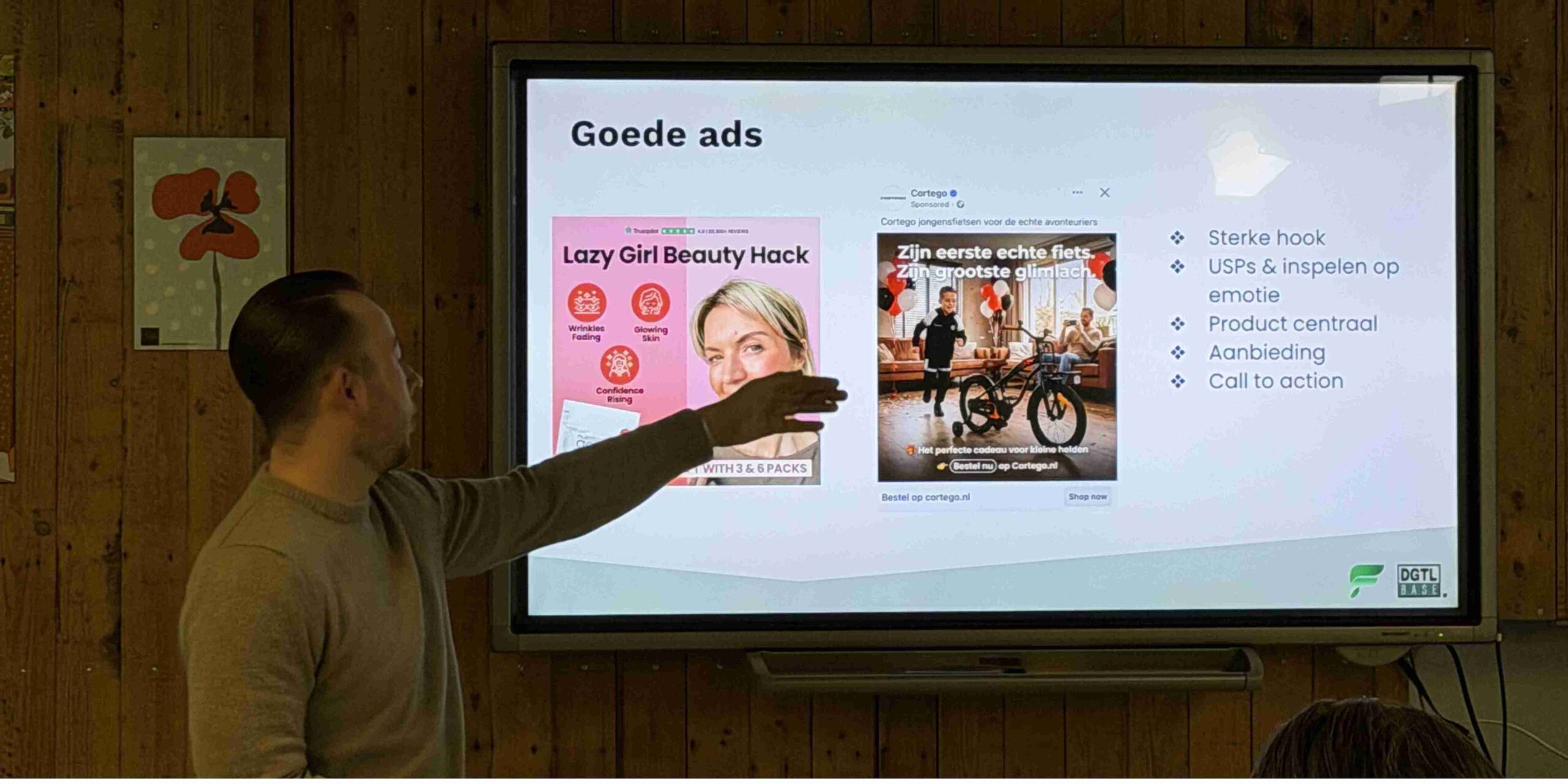
For retail, Meta Ads are strong for visual products where inspiration plays a role. Clothing, home accessories, toys, bikes. They work less well for products people buy based on specifications and price.
The strongest use of Meta Ads for retail is retargeting. Reaching someone who has already visited your website again with a targeted ad is always more effective than reaching people who don’t know you yet.
For retail, Google Ads work best at the moment someone is almost ready to buy. 'Elektrische fiets kopen Amsterdam', 'speelgoed voor 4 jaar cadeau', 'boek over fotografie voor beginners'.
The most common mistake: one broad campaign across the entire range. That is expensive and delivers little. What works: separate campaigns per product category, aimed at people with a clear purchase intent, linking to a page that matches exactly what they are looking for. Not the homepage.
Retargeting is the layer most retailers skip. Someone who visited your website but didn’t buy anything already knows you. They are still hesitating. A targeted ad at the right moment still wins over a large share of those people.
People increasingly ask ChatGPT and Google Gemini for advice before they search on Google. 'Welke fietswinkel in Amsterdam heeft goede service?', 'waar kan ik lokaal speelgoed kopen in Utrecht?'. If your shop isn’t in that answer, you miss the customer before they can even click on an ad.
GEO, Generative Engine Optimization, makes sure your shop is also recommended in AI answers. FAQ content that answers the questions people ask AI, consistent information across all platforms and a strong external profile form the foundation. In the Netherlands, virtually no retailer is actively working on this yet. That makes it an opportunity right now.
Retailers that grow alongside big chains and webshops choose specialisation. They are the expert in their niche, visible on the searches where big chains lose. They use their local presence as a competitive advantage. They write content webshops never write. And they keep existing customers engaged through email.
They don’t grow despite the competition. They grow because they market smarter than the competition.
Curious how DGTLbase approaches this for the retail sector? View our approach to retail marketing or get in touch directly.
We have a small shop with a limited range. Does online marketing still make sense?
Yes! A small range means more focus. You can be the expert in a specific area where big chains are too broad to be truly good. Making that expertise visible online is exactly what sets small retailers apart.
We have a loyal base of regular customers. Why should we invest in attracting new customers?
Regular customers are valuable but not infinite. They move house, change their habits or simply don’t come back one day. A steady stream of new customers alongside your regular base is the only way to grow structurally instead of stagnating.
What is the difference between local SEO and regular SEO for a retailer?
Regular SEO focuses on winning search results on a national or international scale. Local SEO focuses on searches with a geographical intent, “fietswinkel Amsterdam” or “speelgoed kopen Groningen”. For a physical retailer, local SEO is the most relevant and often also the easiest to win.
How do I know which online marketing channels are most suitable for my shop?
That depends on what you sell and who your customer is. As a rule of thumb: local SEO and Google Ads work for virtually every retailer. Meta Ads work well for visual products. Email works for anyone with an existing customer database. Start with the channel closest to your customer and build from there.